The 2026 Shift
Why SAFe Certification is the New Enterprise Standard
The landscape of corporate agility has shifted. As we move through 2026, the question for many IT and business leaders is no longer "Should we be agile?" but "How do we scale it?"
Recent market data reveals that the Scaled Agile Framework (SAFe) has moved beyond a "nice-to-have" credential to a mechanical necessity for professionals navigating large-scale digital transformations. If you are looking to elevate your career or steer your organization through the complexities of modern business, here is why SAFe demand is hitting record highs this year.
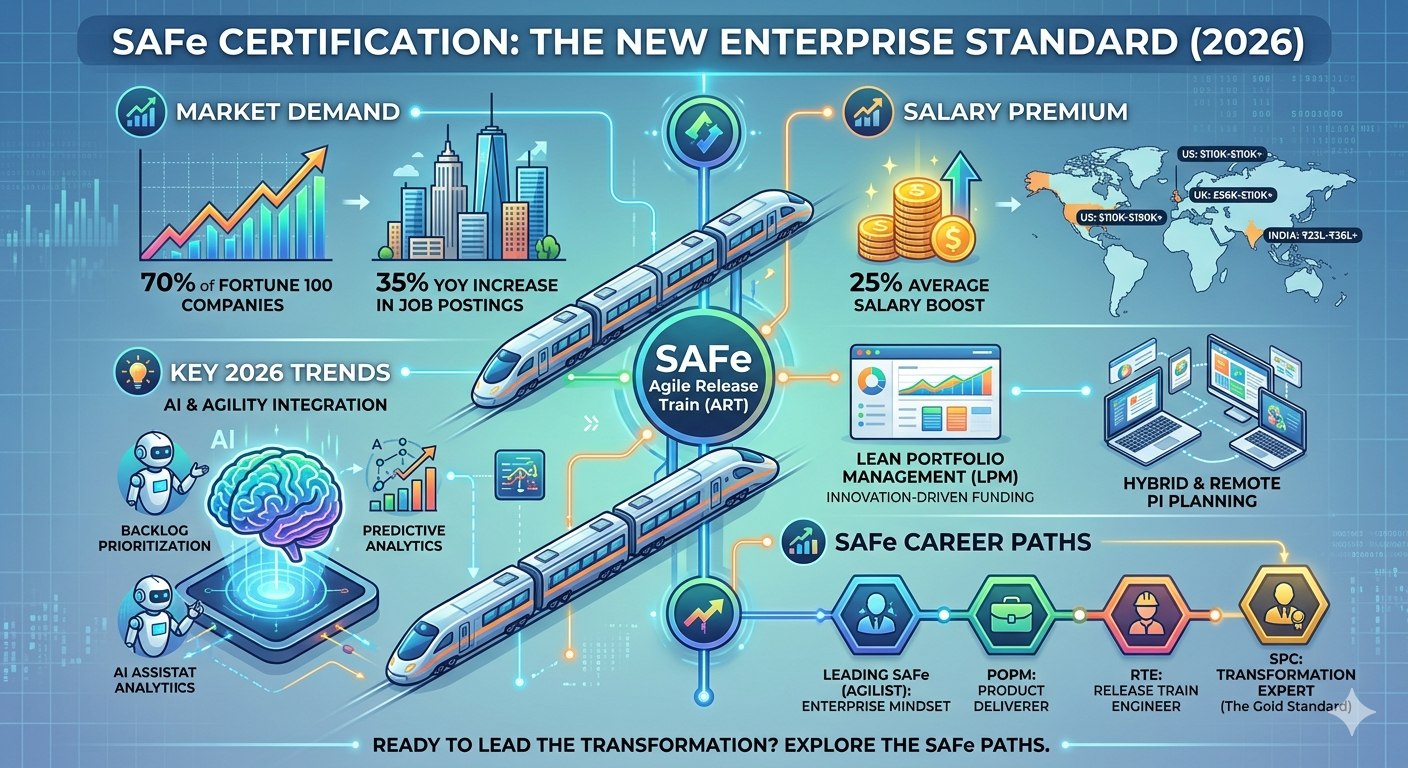
1. The "Fortune 100" Benchmark Today, approximately 70% of Fortune 100 companies have integrated SAFe into their core operations. This widespread adoption has created a massive pull for certified talent. We are seeing a 35% year-over-year increase in job postings that explicitly list SAFe credentials as a requirement.
While the framework was born in IT, 2026 is seeing a massive expansion into:
Healthcare: Navigating complex regulatory environments with speed.
Manufacturing: Integrating hardware and software development cycles.
Government & Defense: Managing massive, multi-vendor programs with transparency.
2. The Financial Edge: A 25% "Certification Premium" The ROI for individual professionals remains clear. Data shows that SAFe-certified practitioners often command 25% higher salaries than their non-certified counterparts.
In the United States, roles requiring advanced SAFe knowledge—such as Release Train Engineers (RTE) or Practice Consultants (SPC)—now range between $110,000 and $190,000+. This global trend is mirrored in the UK and India, where the certification serves as a powerful differentiator in a competitive talent market.
3. Scaling with Intelligence: SAFe and AI The most significant trend of 2026 is the integration of Generative AI into the Agile Release Train (ART). The latest SAFe iterations focus on:
AI-Driven Backlogs: Using predictive analytics to prioritize value.
Accelerated PI Planning: Utilizing AI tools to manage dependencies and risks in real-time.
Lean Portfolio Management (LPM): Moving from rigid annual budgets to "innovation-driven" funding that can pivot as quickly as the market does.
4. Which Path is Right for You? Demand is not uniform; it is specialized. Choosing the right path is essential for maximizing your impact:
For Strategic Leaders: Leading SAFe (SA) provides the blueprint for enterprise-wide Lean-Agile mindsets.
For Value Deliverers: SAFe POPM is critical for those managing the "what" and "why" of product development.
For Transformation Experts: The SAFe Practice Consultant (SPC) remains the gold standard for those who want to coach, train, and lead the entire organizational shift.
The Bottom Line In 2026, agility is the only defense against volatility. A SAFe certification isn’t just a badge on a profile; it is evidence that you understand how to synchronize thousands of people toward a single, high-value goal.
Ready to lead the transformation? Whether you are starting with Leading SAFe or aiming for the SPC, the market is ready for your expertise.
Looking for guidance on which SAFe path fits your career goals? Contact us today for a consultation on Agile coaching and certification strategies.

Ready to put this into practice?
Join a SAFe certification course and master agile at scale.
Browse Courses →

